Root Canal Treatment
Root canal treatment in Handa
Handa root canal treatment
(tooth nerve treatment)
歯科ハミール
Root canal treatment is the last line of defense to “keep your own tooth without extracting it” once decay has reached the tooth’s nerve.
What Is Root Canal Treatment? Treatment to Save Your Tooth
What Root Canal Treatment Involves
Root canal treatment cleans the inside of the canal that houses the tooth’s nerve and removes bacterial infection. It becomes necessary when decay has progressed deep enough to reach the nerve, or when pus has collected at the root tip of a previously treated tooth.
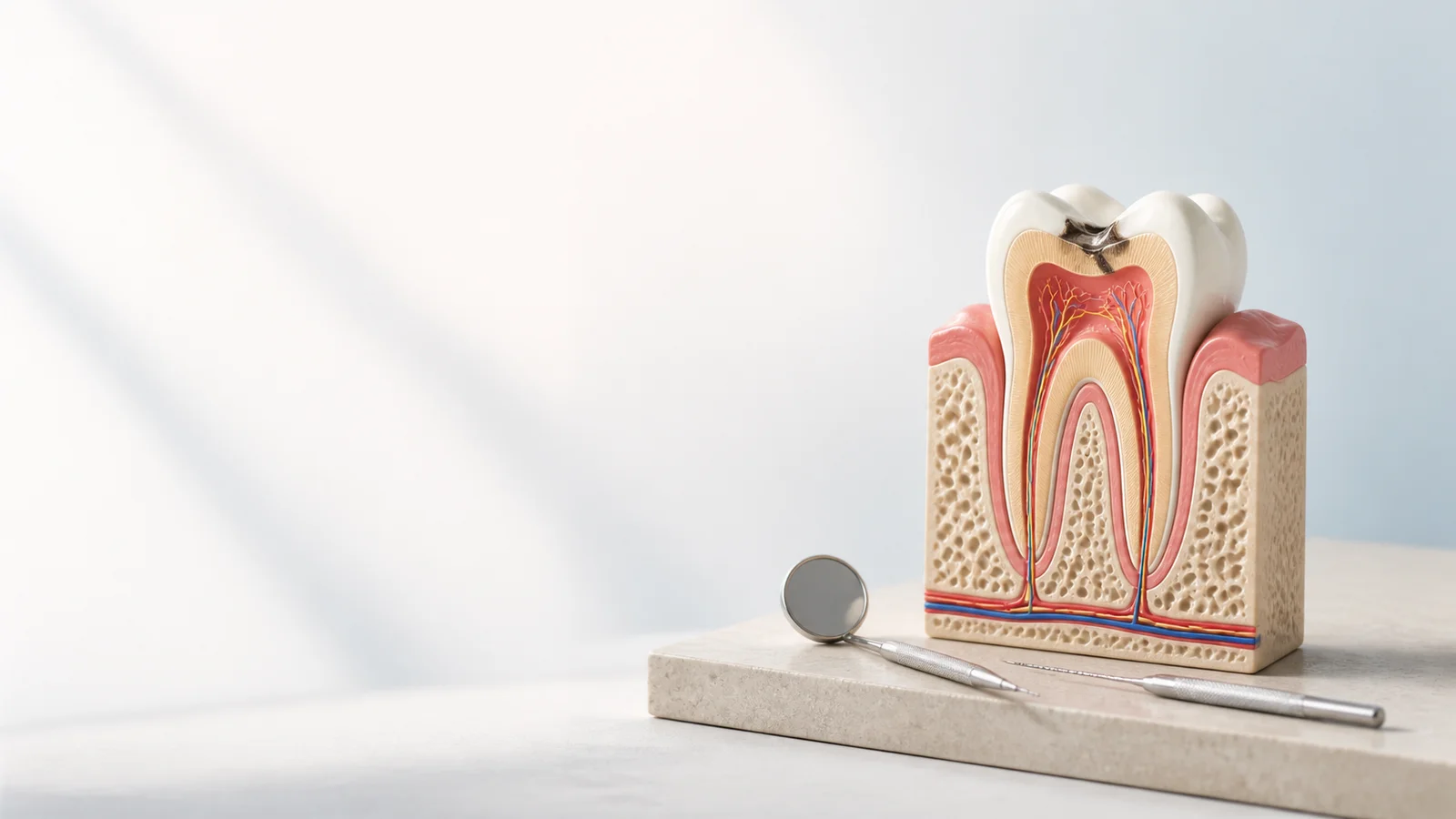
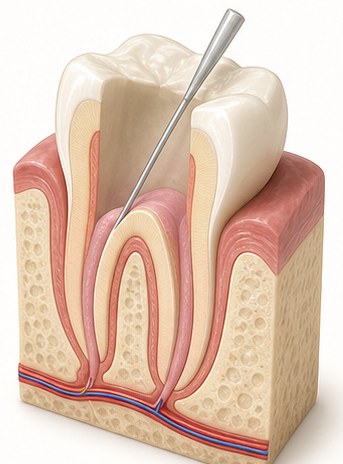
Inside a tooth is a cavity called the pulp, which contains nerves and blood vessels. Once this area becomes infected with bacteria, it can cause severe pain or swelling. Root canal treatment removes the infected pulp, thoroughly cleans and disinfects the inside of the canal, and then fills it with medication, aiming to save the tooth without extracting it.
The Stage of Decay That Requires Root Canal Treatment
Decay progresses from the enamel on the tooth’s surface to the dentin, and then gradually to the nerve (pulp). If it is still confined to the enamel or dentin, a filling can treat it, but once bacteria reach the nerve, a filling alone is no longer enough and root canal treatment becomes necessary. If it is left untreated further and the tooth breaks down extensively, extraction sometimes has to be considered.
Signs That May Indicate You Need Root Canal Treatment
Throbbing pain even when you’re not doing anything, sharp pain on contact with hot or cold food, worsening pain at night that keeps you awake, a jarring pain when chewing, gum swelling with a persistent feeling of something being wrong — these symptoms can all signal that inflammation of the nerve or an infection at the root tip is progressing. If any of these apply to you, we recommend seeing us as soon as possible.
Reasons Root Canal Treatment Becomes Necessary
Reason 1: Decay Has Reached the Nerve
As decay progresses, bacteria reach the nerve. At this stage, sharp throbbing pain continues even when you are doing nothing, and contact with hot or cold food can trigger intense pain. Pain may also worsen at night, seriously disrupting daily life. When these symptoms appear, root canal treatment to remove the nerve becomes necessary.
Learn more about cavity treatment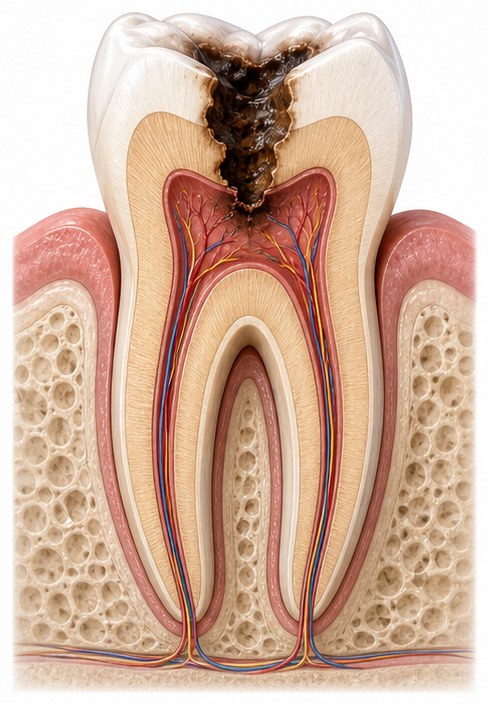
Reason 2: Pus Has Collected at the Root of a Tooth With the Nerve Removed
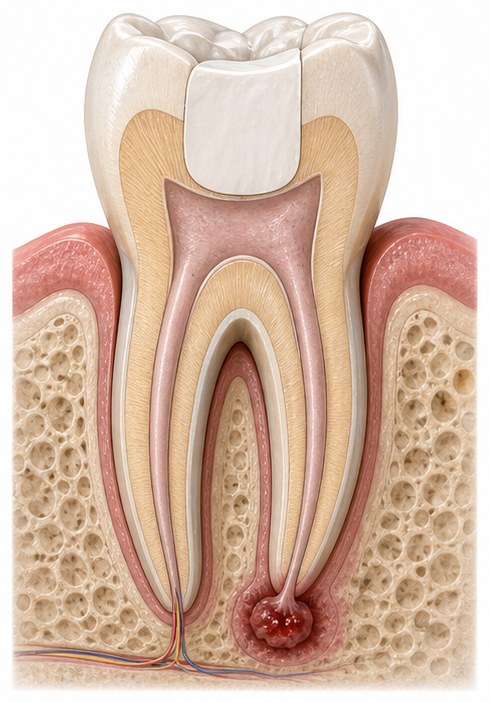
Even a tooth that has already had nerve treatment can develop pus at the root tip over time if bacteria remain there — a condition called apical periodontitis. Symptoms include pain on biting, gum swelling, and a feeling of something being wrong.
If left untreated, the abscess can grow larger and may even cause the whole face to swell or the jawbone to erode. In this case, root canal treatment needs to be redone to clean the inside of the canal again.
Reason 3: A Cracked Tooth or Trauma
A strong impact to a tooth, such as from a fall or an accident, can cause it to break or crack. If the nerve becomes exposed or damaged as a result, root canal treatment may also become necessary.
Learn more about oral surgery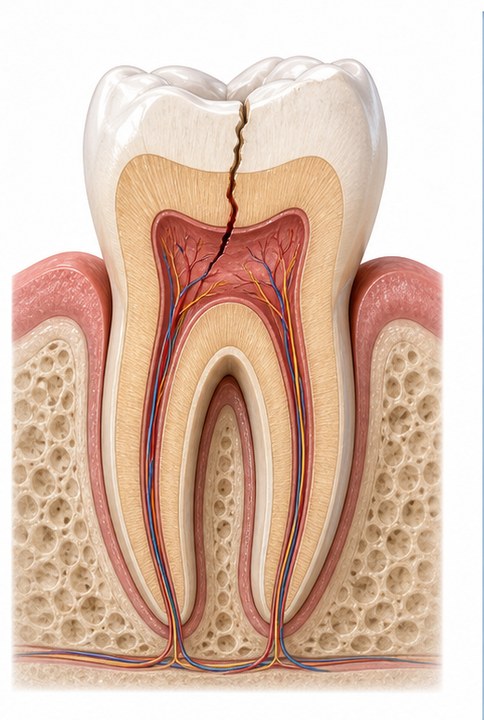
Do You Have Any of These Symptoms?
- Throbbing pain continues even when you’re doing nothing
- Pain when chewing / gum swelling
- A lingering feeling of something wrong after a tooth was struck
4 Types of Root Canal Treatment
Root canal treatment is a general term, but the approach differs depending on the condition of the tooth. It can broadly be divided into the following 4 types.
Type 1: Pulpectomy (Removing the Nerve)
This treatment removes a severely inflamed nerve caused by decay or trauma. It is used on teeth whose nerve is still alive, removing the cause of pain while aiming to save the tooth itself.
Type 2: Infected Root Canal Treatment (Draining Pus)
This treatment is for teeth whose nerve has already died and bacteria have multiplied inside the canal, or teeth with pus at the root tip. It removes the infected tissue, cleans and disinfects the inside of the canal, and gradually eliminates the cause of the pus.
Type 3: Retreatment (Redoing Root Canal Treatment)
This treatment is for a tooth that has already had root canal treatment but has become infected again: the crown and post are removed, the previously filled material is taken out, and the inside of the canal is cleaned again. It is usually more complex than first-time treatment and requires a more time-consuming, careful approach.
Type 4: Apicoectomy (Surgical Treatment)
When conventional root canal treatment shows no improvement, or when the lesion at the root tip is large, surgery called an apicoectomy may be performed. This method directly removes the root tip and the lesion.
We perform apicoectomies depending on the case. If more specialized treatment is needed, we will refer you to an appropriate medical institution. Please consult us first.


Why Root Canal Treatment Recurs Often in Japan
Root canal treatment is a type of treatment that can recur some time after it is completed, and such cases are not uncommon. The main causes can be summarized in the following 3 points.
Reason 1: Bacteria Left Behind Inside the Canal
Root canals are extremely narrow, often curved and branching, with a complex structure. If bacteria remain in spots that are hard to see with the naked eye, it can become the cause of the inflammation recurring later.
Reason 2: Re-infection From Saliva During Treatment
Saliva contains large amounts of bacteria. If saliva gets inside the canal during treatment, the canal that has only just been cleaned can become infected again. This is exactly why moisture-control measures during treatment are so important.
Reason 3: Bacteria Entering Through Gaps in the Filling
If there are gaps in the medication filled into the canal or in the crown, bacteria can enter through them and cause the root tip to become inflamed again. Both a tight filling and a high-precision crown are key to preventing recurrence.
Features of Our Precision Root Canal Treatment
Feature 1: Magnifying the Canal With a Microscope
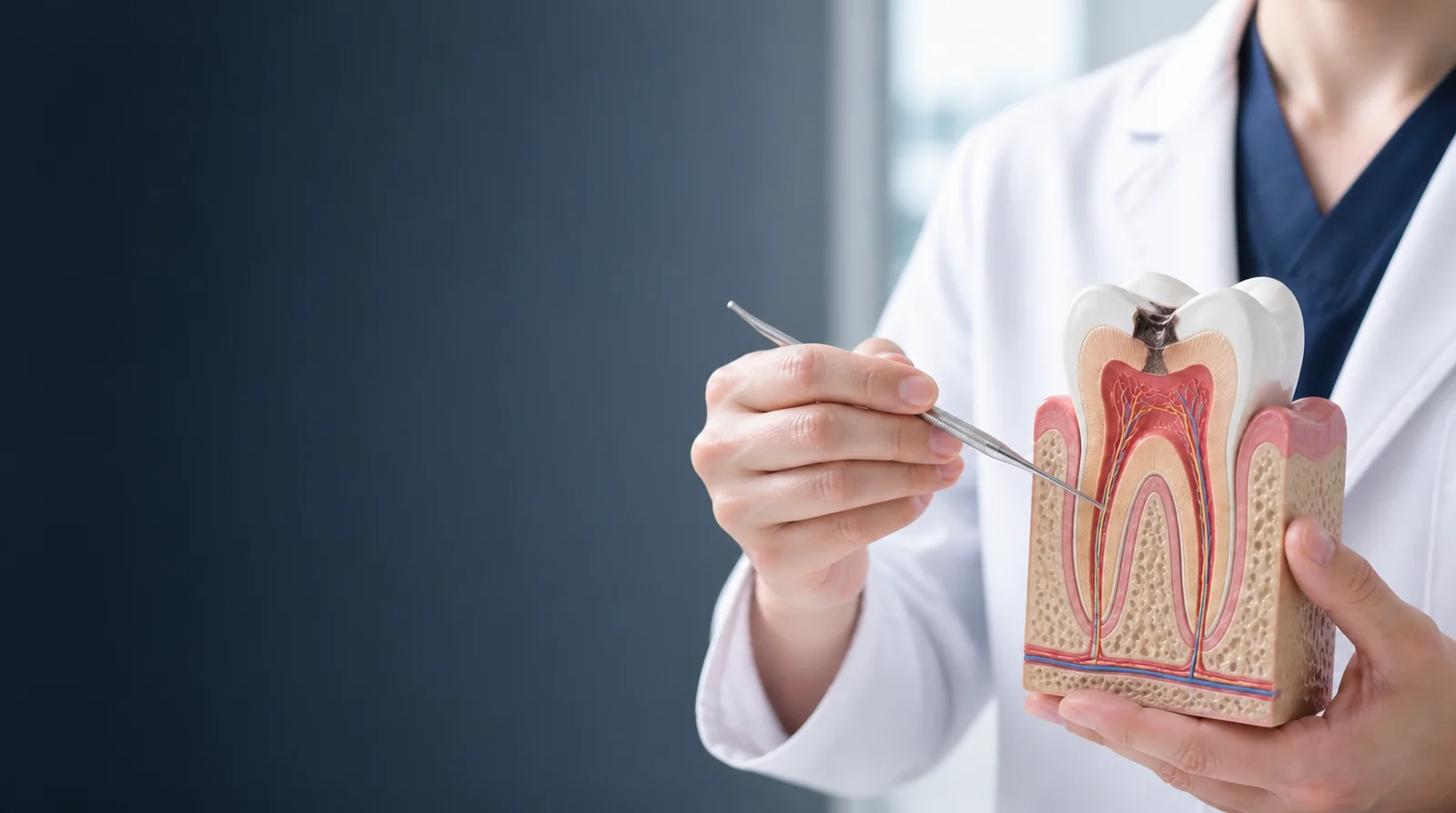
By magnifying the inside of the canal with a dental microscope before treating it, we can address even the fine details that are hard to see with the naked eye. Reducing leftover bacteria helps lower the risk of recurrence.
Feature 2: Diagnosing Root Shape in 3D With Dental CT
Taking a dental CT scan in addition to X-rays lets us grasp the number of roots, how they curve, and the size of the lesion in three dimensions. The precision of grasping this three-dimensional shape directly affects the precision of the treatment plan.
Feature 3: Using a Rubber Dam to Block Saliva
Depending on the case, we perform root canal treatment using rubber dam isolation. A rubber dam is a rubber sheet that isolates only the tooth being treated, preventing saliva and bacteria from getting in.
For root canal treatment to succeed, keeping the inside of the canal sterile is extremely important. Saliva contains large amounts of bacteria, and if it gets inside the canal during treatment, it becomes a cause of re-infection. Using a rubber dam allows treatment to be carried out in a clean environment, lowering the risk of re-infection.
Feature 4: Using NiTi Files for Complex Canals
Using highly flexible nickel-titanium (NiTi) alloy files makes it easier to follow the curve of the canal, allowing even complex-shaped canals to be cleaned in full.
Feature 5: Sealing the Canal Tightly With MTA Material
Depending on the case, we use MTA material, which offers both excellent sealing ability and biocompatibility, to seal the canal tightly and avoid leaving gaps that bacteria could enter again.
The Flow of Root Canal Treatment
Step 1: Examination, Diagnosis, and Explanation
We first ask about your pain and past treatment history, then take X-rays and a CT scan to check the shape of the root and the size of the lesion. Based on the results, we explain in detail why root canal treatment is needed, how it will proceed, and roughly how many visits to expect. Please feel free to ask any questions at any time.
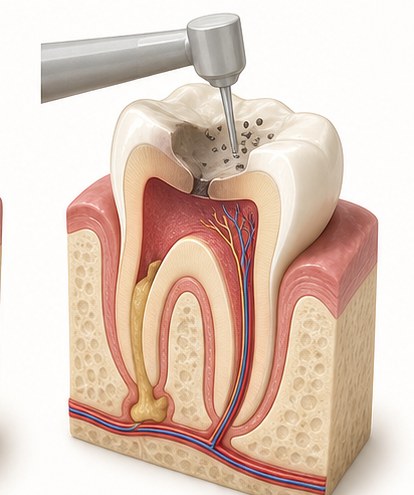
Step 2: Anesthesia and Removal of the Infected Area
After anesthesia, we remove the decayed part and the infected nerve. Depending on the case, we use a rubber dam to protect the tooth from saliva while we work.
Step 3: Measuring the Length of the Canal
We use an electronic apex locator to accurately measure the length to the root tip. The “beep-beep-beep” sound you hear during treatment is this device operating; it does not cause any pain, so there’s no need to worry.
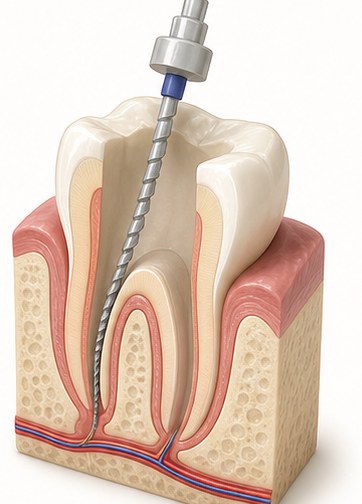
Step 4: Cleaning and Disinfecting the Inside of the Canal
We clean every part of the inside of the canal with dedicated instruments and rinse and disinfect it with medicated solution. To avoid leaving any infection in fine details, this step is repeated several times to keep the inside of the canal clean.
Step 5: Canal Filling (Sealing With Medication)
Once the inside of the canal is clean, we fill it with the final medication and seal it to keep bacteria out. Leaving no gaps during filling is a key point in preventing recurrence.
Step 6: Fitting the Post and Crown
After the post is placed, the tooth is restored with a crown to bring back its original shape and function. You can choose anywhere from insurance-covered materials to self-pay ceramic, according to your wishes.
Learn more about ceramic crowns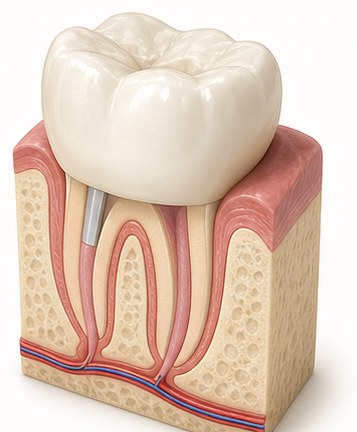
Number of Visits and Treatment Period for Root Canal Treatment
“How many visits will it take?” is one of the most common questions about root canal treatment. Below is a general guide broken down by type of treatment.
Number of Visits for Pulpectomy
For pulpectomy, which removes the nerve, a few visits are generally the guide. If the inside of the canal is stable, treatment can progress to the filling stage in relatively few visits. ※The number of visits varies depending on the condition of the tooth.
Number of Visits for Infected Root Canal Treatment / Retreatment
When there is pus at the root tip, or when it is a retreatment case, the inside of the canal needs to be cleaned and disinfected repeatedly, so more visits are generally needed than for pulpectomy. We will explain the treatment plan and roughly how many visits to expect at your first appointment, and adjust the schedule to fit your availability.
3 Reasons Treatment Can Take Longer
- The canal is narrow and complex in shape, so cleaning takes more visits
- The lesion at the root tip is large, requiring repeated disinfection and monitoring of recovery
- In retreatment, removing the previous filling material and post takes time
Root Canal Treatment Fees (Insurance / Self-Pay)
So that you don’t begin treatment with lingering concerns about cost, we first explain the basic structure of the fees.
Fee Guide for Insurance-Covered Root Canal Treatment
Root canal treatment can be received under insurance. Insurance fees are set based on a nationwide, uniform treatment-fee point system, and vary depending on the tooth’s location (front tooth, premolar, or molar), the number of roots, and the content of treatment. The cost of the post and crown is calculated separately.
At the examination and diagnosis stage, we will explain the approximate cost based on the condition of your mouth; please feel free to ask us about anything you’re unsure of.
Fee Guide for Self-Pay Precision Root Canal Treatment
Self-pay precision root canal treatment has fewer restrictions on treatment time and the equipment and materials used; it is elective treatment that takes more time to carry out a precise procedure. The specific items and fees at our clinic will be explained based on the condition of your mouth at the time of diagnosis.
The Difference Between Insurance and Self-Pay
The feature of insurance-covered treatment is that you receive standardized treatment under nationwide, uniform rules. Self-pay treatment, on the other hand, offers a wider choice of equipment, materials, and treatment time, allowing for a more precise procedure. Which is more suitable depends on the condition of the tooth, and we will explain this to you after diagnosis.
About Pain During Root Canal Treatment
Our Consideration for Pain During Treatment
Because anesthesia is used, you will feel almost no pain during treatment. Our clinic uses topical anesthesia and an electric syringe to keep even the pain of the anesthetic injection to a minimum.
How Long Pain May Last After Treatment
For a few days after root canal treatment, you may feel something odd or slight pain when chewing. This is a temporary inflammatory reaction caused by the treatment and usually settles down gradually. If the pain is severe, we will prescribe pain medication, so please don’t try to endure it — let us know right away.
Possible Reasons if Pain Continues
If pain lasts for a long time, possible causes include the bite being too high, inflammation still remaining inside the canal, or a fine crack in the tooth. If the pain has not settled after several days, or is gradually getting worse, please contact us as soon as possible.
If Another Clinic Has Told You an Extraction Is Needed
Even if you were advised to have an “extraction” because of pain or swelling, please consult us once before giving up — there may still be a chance to save the tooth.
Cases Where Root Canal Treatment May Save the Tooth
Even when the lesion at the root tip is large, as long as the root itself remains intact, it may be possible to save the tooth with retreatment or an apicoectomy. Please let us check your specific condition before deciding.
Cases Where Extraction Is Necessary
In cases such as a large crack in the root, or extensive loss of the bone supporting the tooth, saving the tooth can actually carry risks, and in these cases we may also recommend extraction. Even then, we will explain the options after extraction in detail as well.
Second Opinion Consultations
Even if another clinic has diagnosed you as needing an extraction, after examining you we will explain the possibility of saving the tooth and the treatment options available. We also accept consultations as a second opinion, so please feel free to contact us at any time.
To Prevent Recurrence After Treatment
The Importance of Protecting the Tooth With a Crown
A tooth that has had its nerve removed becomes more brittle than a healthy tooth, since its supply of nutrients and moisture has been cut off. That is why reinforcing it with a solid crown is so important. A high-precision crown not only prevents bacteria from entering through gaps, it also plays an important role in preventing recurrence.
Catching Recurrence Early With Regular Checkups
Even after treatment is finished, it is very important to have regular checkups with X-rays to confirm the condition of the root tip and the crown. Catching signs of recurrence early gives you more options for how to respond. We also offer professional cleaning by our dental hygienists.
Learn more about preventive dentistryRoot Canal Treatment FAQ
Q1. What Is the “Beep-Beep-Beep” Sound During Treatment?
It’s the operating sound of the device (an electronic apex locator) that measures the length of the canal. This device electronically measures the distance to the root tip, and the sound itself carries no pain or danger, so there’s nothing to worry about.
Q2. What Happens if I Don’t Get Root Canal Treatment?
Decay or a root infection will not heal on its own, and leaving it untreated only lets the infection keep spreading. Even if the pain temporarily subsides, it is often still progressing inside, and as time passes, the chance of saving the tooth decreases and your treatment options narrow. Please consult us as early as possible, before it reaches the point of extraction.
Q3. What Should I Do if the Temporary Filling Comes Out?
A temporary filling can come loose if you bite something hard. If it is left out, bacteria will get inside the canal, so please contact us as soon as possible. We will take care of it right away, without waiting for your next scheduled appointment.
Q4. Does Pain When Chewing After Treatment Mean It Failed?
A feeling of something odd or slight pain within a few days of treatment is mostly a temporary inflammatory reaction that comes with treatment, and it does not necessarily mean it has failed. It usually settles down gradually, but if the pain gets worse or continues for a long time, adjustments such as to the bite may sometimes be needed, so please contact us.
Q5. Does Root Canal Treatment on a Front Tooth Affect Its Appearance?
A tooth that has had its nerve removed may discolor over time. For a front tooth, a natural appearance can be restored with a ceramic crown and similar options — if you’re concerned about appearance, please consult us.
Struggling With Root Canal Treatment? Visit the Dental Clinic 1 Minute From Sumiyoshicho Station
Do Any of These Concerns Sound Familiar?
- Your tooth throbs even when you’re doing nothing
- Another clinic told you “extraction is the only option”
- Root canal treatment left unfinished partway through
- A treated tooth still hurts or feels odd when chewing
Booking & Inquiries
歯科ハミール performs precision root canal treatment aimed at saving as many of our patients’ teeth as possible. If you’re troubled by pain, or have been told elsewhere that you need an extraction, please consult us once first. Our clinic is a 1-minute walk from Meitetsu Sumiyoshicho Station. We propose a treatment plan matched to each patient’s situation.