


Preventive Dentistry
Treatment Menu
Preventive Dentistry
歯科ハミール
The old mindset of “only going to the dentist once a tooth hurts” leads to a repeating cycle of drilling, filling, and “repair,” until you eventually lose a precious tooth.
“Preventive dentistry,” which heads off cavities and periodontal disease before they start, is the shortest path to enjoying food with your own teeth for a lifetime.
Regular professional cleanings and science-based risk checks catch trouble while it’s still small, greatly reducing future pain and costly treatment. Let’s work together with 歯科ハミール in Handa to protect and nurture a smile that stays healthy and confident 10, even 20, years from now.
Building a future where you keep as many of your own teeth as possible, through preventive dentistry
The old mindset of “only going to the dentist once a tooth hurts” leads to a repeating cycle of drilling, filling, and “repair,” until you eventually lose a precious tooth. “Preventive dentistry,” which heads off cavities and periodontal disease before they start, is the shortest path to enjoying food with your own teeth for a lifetime.
Regular professional cleanings and science-based risk checks catch trouble while it’s still small, greatly reducing future pain and costly treatment. Let’s work together with 歯科ハミール in Handa to protect and nurture a smile that stays healthy and confident 10, even 20, years from now.

Two pillars of preventive dentistry
Professional care (care at the dental clinic)
Daily brushing alone will always leave behind buildup that’s hard to remove on your own (biofilm and tartar). Thoroughly clearing this away with specialized instruments is the professional care a dental clinic provides.
Every patient’s oral environment and habits are different. That’s why we use a professional eye to spot the spots your brushing tends to miss, and recommend the toothbrush and brushing method that best suit you. To keep your mouth healthy, we recommend professional care once every 3 to 4 months.
What care looks like at the clinic
Step1. Oral health check
We photograph your mouth’s current condition with a camera, and explain it to you in simple terms together while looking at the monitor.
Step2. Scaling (tartar removal)
A specialized ultrasonic instrument vibrates away hardened tartar that a toothbrush can’t remove.
Step3. PMTC (professional deep cleaning)
Using a special cleaning paste and a soft brush tip, we polish away the invisible bacterial film (biofilm) until it’s smooth and gone.
Step4. Personalized brushing guidance
We point out the spots where buildup tends to remain, and teach you an effective brushing method you can start using tomorrow.
Step5. High-concentration fluoride application
We apply fluoride to your freshly cleaned tooth surfaces, building tooth structure strong enough to resist acid from cavity-causing bacteria.
Preventive programs and fees
| Program | What’s included | Recommended frequency | Price (tax included) |
|---|---|---|---|
| Basic maintenance (approx. 45 min) |
Periodontal check + PMTC (cleaning) + fluoride application | Every 3–6 months | ¥5,500 |
| Pro care plus (approx. 60 min) |
Basic program + air-flow polishing (stain removal) + saliva test | Every 6 months | ¥8,800 |
| Kids’ Prevention Club | Fluoride application (3x/year) + sealants + fun picture-card guidance | Through 6th grade | Annual fee ¥3,300 |
| Maternity program | Periodontal check for expectant mothers + brushing guidance + PMTC | Second trimester (stable period) | ¥5,500 |
| Sports mouthguard fabrication | Precision impression + choice of color | (discount available for junior high and high school students) | ¥13,200 |
*Air-flow polishing uses a fine powder and a high-pressure water jet to blast away stains such as tea discoloration without damaging the tooth. It’s also recommended before whitening.
5 reasons patients choose our Handa clinic for preventive dentistry
Supported throughout by a nationally licensed “dedicated dental hygienist”
Our clinic uses a “dedicated hygienist” system, assigning each patient their own dental hygienist.
Because the same staff member checks your mouth’s subtle changes every time, no small change goes unnoticed, and we can move toward your goal together, side by side.
Analyzing your cavity risk scientifically with a “saliva test”
A test (SMT) that measures the amount and quality of your saliva and your bacterial counts reveals, with scientific data, exactly why you’re prone to cavities.
We then offer you a custom prevention plan built just for you, not based on guesswork.
Thorough disinfection with laser and antibacterial gel
For patients concerned about advancing periodontal disease, we combine an Er:YAG laser — which uses a water spray to ease discomfort — with an antibacterial gel to thoroughly eliminate periodontal bacteria.
This resets even the areas deep inside periodontal pockets that instruments can’t reach to a clean state.
A full diagnosis using CT and digital equipment
Besides buildup on the teeth, a poor bite is another major reason teeth don’t last as long as they should. We use CT and a 3D scanner to grasp risks invisible to the eye in three dimensions, and build prevention around the balance of your whole mouth.
Saturday appointments until 5pm, plus ample parking
Making prevention a habit depends above all on how easy it is to visit. So that patients who are busy on weekdays can still come without strain, our clinic also sees patients on Saturdays until 5pm.
We also have ample parking (13 spaces), so driving here isn’t a worry.
Precision exams for prevention
A full oral exam and diagnosis
First, we take the time to examine your mouth as a whole.
・Checking whether existing fillings or crowns have developed gaps (from wear and aging)
・Whether any new cavities have formed
・Whether any teeth feel loose
・Whether your tongue or mucous membranes show anything unusual, and more.
Precision exam for periodontal disease (gums)
We measure how far periodontal disease — the leading cause of tooth loss — has progressed.
・Using a specialized instrument to measure, in millimeters, the depth of the gap between tooth and gum (periodontal pocket)
・Checking for bleeding or discharge caused by inflammation.
X-ray imaging diagnosis
We look for internal problems invisible from the surface.
・Whether the jawbone supporting the teeth has begun to resorb
・Whether a cavity is hiding between teeth
・Checking for a lesion at the tip of a tooth root.
Intraoral photography
We use specialized imaging equipment to keep a record, so we can compare your mouth before and after treatment, or years ago and now.
Even areas you can’t normally see yourself, like the back of your molars, can be checked together on the monitor.
Why scaling (tartar removal) matters
Buildup on the teeth (plaque), left alone, combines with components in saliva and hardens into “tartar” in as little as 2–3 days. Because tartar’s surface is rough like pumice, fresh bacteria attach to it and multiply rapidly, worsening periodontal disease.
No matter how hard you scrub with a toothbrush, you can’t remove this tartar yourself. “Scaling” is a procedure that breaks up this stubborn tartar bit by bit and removes it, using ultrasonic vibration and similar methods.
Tartar is said to build up in over 90% of adults, and even after a thorough cleaning it will reattach over time. That’s why regularly having a professional reset your mouth’s condition — before your gums become red and swollen or the jawbone starts to resorb — is essential.
PMTC (Professional Mechanical Tooth Cleaning)
PMTC is a thorough professional cleaning performed by a hygienist trained specifically for it at the dental clinic.
Using special soft rubber cups or brush tips, we thoroughly clear out both the gaps between teeth that a toothbrush’s bristle tips can never quite reach in daily brushing, and the “biofilm” (a stubborn bacterial barrier, much like the slime in a kitchen sink) hiding deep in periodontal pockets.
We finish by polishing the tooth surface smooth, so new buildup and stains have a harder time sticking. Beyond preventing cavities and periodontal disease, many patients come almost the way they’d visit a spa, saying things like “my teeth feel so smooth!” or “the tea stains are gone and my teeth are a shade brighter!” — it’s one of our most popular programs.
Daily “home care” is the key to success
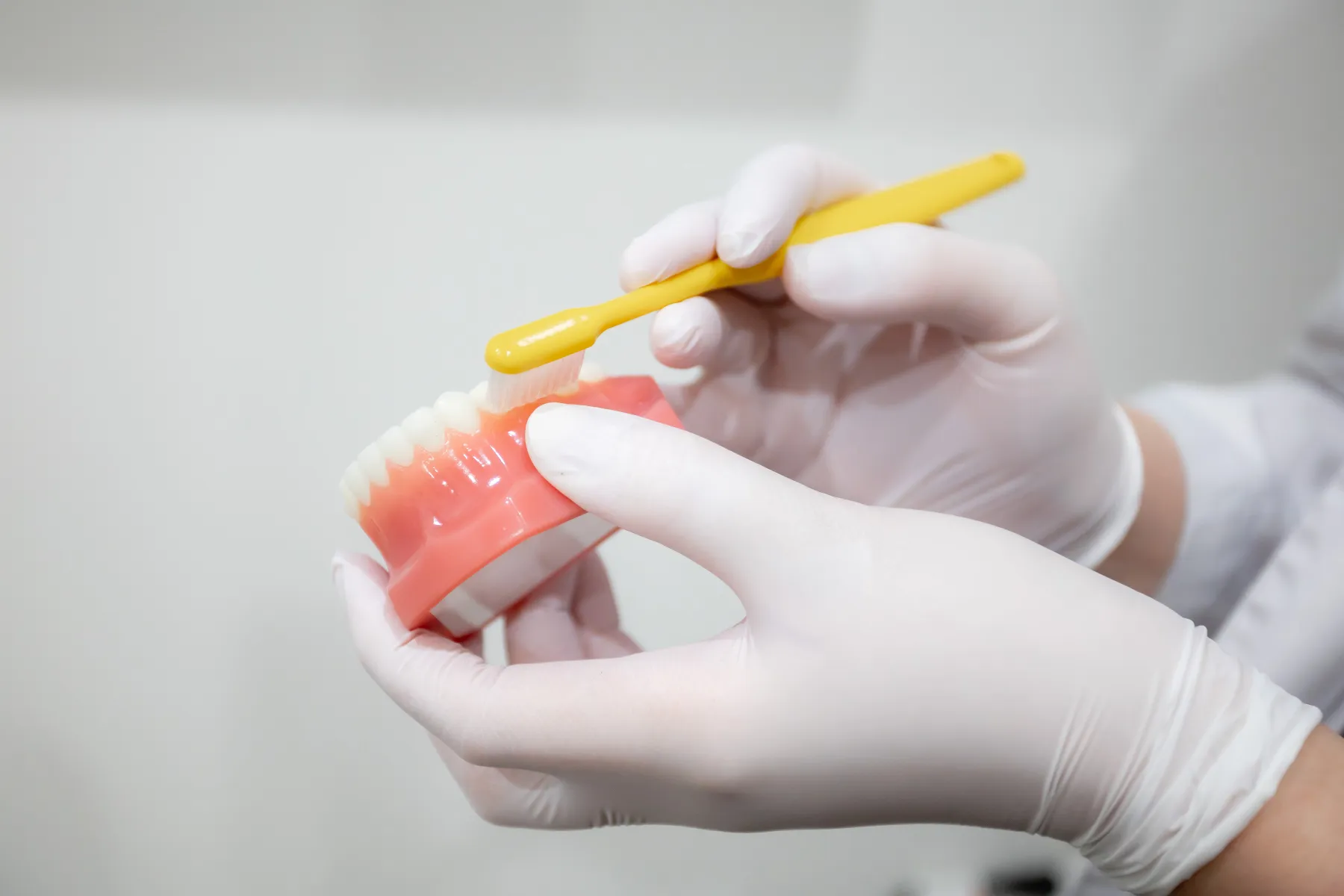
However many times you get a perfect cleaning at the clinic every few months (professional care), if your daily brushing at home (home care) is still done your own improvised way, bacteria will quickly multiply again.
In preventive dentistry, the most important thing is keeping both wheels — “professional care” and “home care” — turning together. We don’t stop at simply removing tartar; we take the time to teach you the “correct home-care method that actually works,” matched to your mouth’s shape and your lifestyle. Let’s work together to build a healthy mouth people will still compliment 10 years from now.
3 points for home care
Don’t rinse away fluoride’s protective barrier
After brushing with fluoride toothpaste, do you rinse your mouth with water several times? To let the active ingredient stay in your mouth, the trick to getting its full effect is limiting your rinse to “a small amount of water, about 5 seconds, just once.”
Getting rid of the illusion that you’ve “brushed it clean”
Plaque is a colony of bacteria. Rather than brushing absent-mindedly while watching TV, try building the habit of brushing in front of a mirror at first, checking that the bristle tips are actually reaching the line where tooth meets gum.
Using auxiliary tools to eliminate bacteria’s hiding places
A toothbrush alone removes only about 60% of the buildup in your mouth. To clean the “gaps between teeth,” where the remaining 40% accumulates, be sure to add dental floss, an interdental brush, and a mouthwash before bed to your daily care routine.
The flow of regular checkups and cleaning
1. Booking
Please book your checkup through our online booking form, available 24 hours, or by phone.
2. Consultation and oral exam
We’ll first ask about anything you’ve been concerned about lately, and anything you find difficult about your daily care. The dentist or your dedicated hygienist will then examine your mouth, checking every corner for any new cavities or swollen gums. (*If a cavity requiring treatment is found, that treatment will take priority.)
3. Cleaning and advice
Based on the exam results, we’ll walk you through an effective brushing method for the spots you tend to miss. We’ll then use specialized instruments to thoroughly clean away the tartar, biofilm, and staining that home care can’t remove.
4. Guidance for your next visit
Once your mouth feels fresh and clean, today’s care is complete. Based on your personal risk level (how prone you are to cavities or periodontal disease), we’ll suggest a timeframe of 3 months to half a year for your next visit. Just like visiting a hair salon or beauty salon, we welcome you to come refresh regularly.
FAQ
Q1. Can I come in even if nothing hurts? (About how often should I visit?)
Of course! In fact, coming in before anything hurts is the whole point of preventive dentistry. How often you should visit varies with your mouth’s condition, but we generally recommend once every 3 to 4 months.
Q2. Is cleaning (preventive dentistry) covered by health insurance?
If it’s ongoing care (SPT) aimed at treating periodontal disease and preventing it from recurring, it can be covered by health insurance. Cosmetic PMTC aimed purely at removing stains, for example, may fall under out-of-pocket treatment, and we’ll explain this to you in advance.
Q3. I’m afraid of that stinging “buzzing” feeling during scaling…
For patients prone to sensitivity, we lower the ultrasonic instrument’s output or switch to a hand instrument (hand scaler) to gently remove buildup, doing everything we can to minimize discomfort. Please don’t hesitate to let us know at any time.
Booking & Inquiries