


Periodontal Regeneration
Treatment Menu
Periodontal Regenerative Therapy
歯科ハミール
Have you ever thought, “All I can do is try to stop my periodontal disease from getting any worse…” and half given up on saving your own teeth? The treatment using digital equipment offered at our Handa clinic may be able to bring bone that has already dissolved closer to its original, healthy state.
Don’t Give Up. The Hope of Periodontal Regeneration
From “Slowing the Progression” to an Era of “Restoring the Original State”
Have you ever thought, “All I can do is try to stop my periodontal disease from getting any worse…” and half given up on saving your own teeth? The treatment using digital equipment offered at our Handa clinic may be able to bring bone that has already dissolved closer to its original, healthy state.
If You’d Like to Learn the Basics of Periodontal Disease First
About periodontal disease treatmentIs It True That “Bone That Has Dissolved Can’t Come Back”?
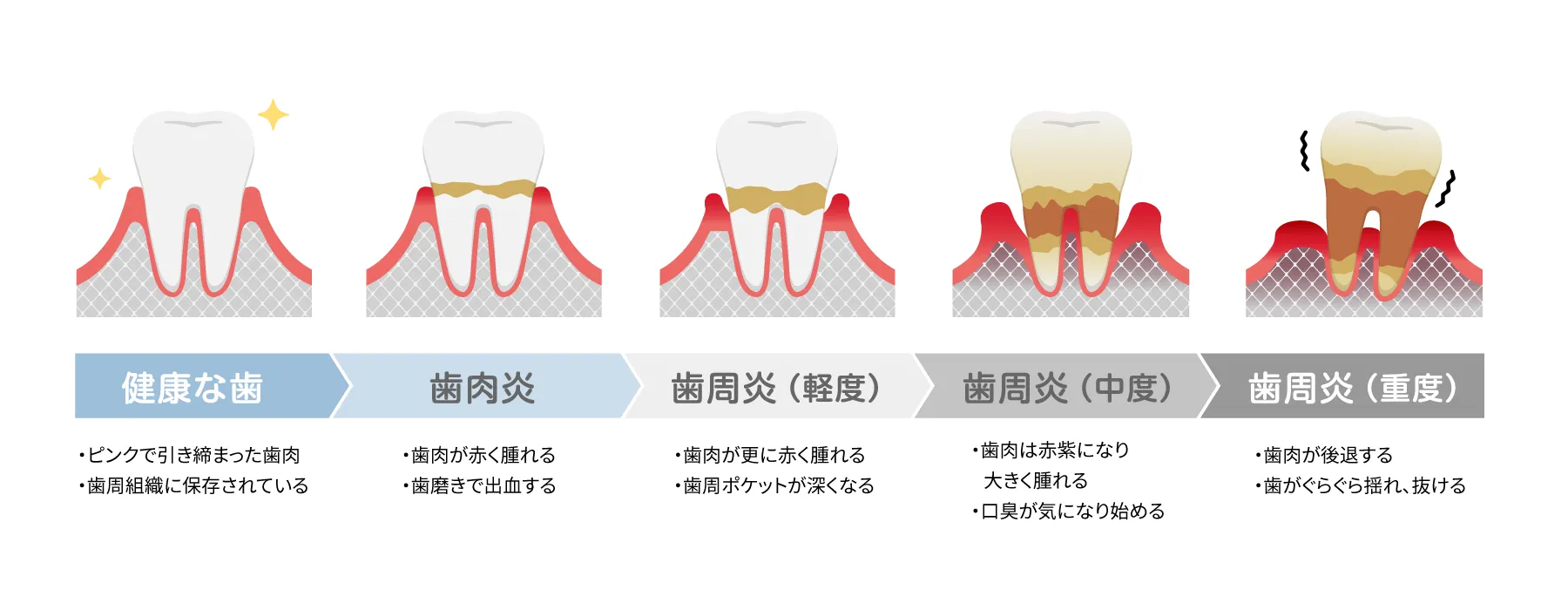
Periodontal disease was once feared as an “incurable disease” that people thought could only be waited out until their teeth fell out. Today’s standard periodontal treatment, by removing the underlying cause (tartar and plaque) and calming the inflammation, is now fully capable of “stopping further progression (maintaining the current state).”
However, basic treatment alone could not restore the jawbone (alveolar bone) supporting the teeth, or gums that had already receded, to their original height.
In fact, within the scope of standard insurance-covered treatment, the extent of regeneration possible is limited.
“Regeneration” Technology That Brings Lost Tissue Back to Life
But dental medicine has advanced remarkably in recent years, and periodontal treatment has shifted from the defensive stage of “stopping progression” to the offensive stage of “regenerating” what was lost. That is exactly what “periodontal regeneration treatment” does, using digital equipment to bring destroyed bone and tissue back to life at the cellular level.
If you’ve been told by another clinic that “severe periodontal disease means extraction is the only option,” or you’re troubled by the appearance of severely receded gums, please don’t give up — come consult 歯科ハミール in Handa. With today’s regenerative treatments, there is still a chance to save your precious teeth.
Choices That Can Greatly Extend the Life of Your Own Teeth.
Bone Regeneration With the Emdogain Method (EMDG)
When periodontal bacteria cause inflammation deep beneath the gums and the bone supporting the teeth has dissolved to the point where teeth become loose, this is an innovative treatment that strongly promotes the regeneration of lost bone and tissue.
What Kind of Medication Is Emdogain?
Emdogain gel is a medical material whose main ingredient is a “protein” that is active while teeth are erupting, and it promotes the regeneration of periodontal tissue.
Applying this gel to a cleaned root surface makes the body behave as if “a new tooth is about to erupt,” prompting it to start rebuilding tissue such as the bone supporting the tooth (the alveolar bone) and the cushioning periodontal ligament. This medication has been used for many years around the world, and in Japan it has been formally approved by the Ministry of Health, Labour and Welfare (MHLW).
- Symptoms This Treatment Is Suited For
- ○ Vertical bone defect: the bone around a tooth has dissolved deeply, as if scooped out into a cup shape.
○ Furcation involvement: the bone has dissolved into a hollow where the roots of a multi-rooted tooth, such as a molar, branch apart.
○ Gingival recession: bone loss has caused the gums to recede severely, leaving the tooth root exposed.
Our Emdogain Treatment Flow
1. Incision
Once the local anesthetic has taken full effect, we open the gum at the area to be treated with care.
2. Thorough Cleaning
We thoroughly remove the stubborn tartar and infected tissue attached to the root that is causing the bone loss, using dedicated instruments.
3. Applying the Gel
We generously apply Emdogain gel, which promotes tissue regeneration, to the cleaned root surface.
4. Suturing and Waiting for Healing
The opened gum is put back in place and carefully sutured. After that, it takes several months to about half a year for the bone to slowly regenerate.
About the GTR Method (Guided Tissue Regeneration)
Alongside Emdogain, one of the other leading treatments for bone regeneration is the “GTR method.” In this method, a “special artificial membrane” is placed over the area where bone has been lost, to block gum tissue from growing into the space, buying time for the bone underneath to slowly grow.
Years of research have shown its bone-regenerating effect to be comparable to the Emdogain method, but it has drawbacks: placing the membrane accurately requires extremely high skill, and there is a risk of the membrane becoming exposed after surgery and causing a bacterial infection.
※At present, the “Emdogain method,” which carries a lower infection risk and a simpler procedure, is the mainstream approach in dental care worldwide, and we too put patient safety first, mainly offering regenerative treatment centered on Emdogain.
Using the Artificial Bone “Bio-Oss”
When severe periodontal disease has caused extensive bone loss and Emdogain alone is unlikely to achieve sufficient bone regeneration, we combine it with a “bone substitute material (artificial bone)” that stands in for bone — an advanced treatment approach.
What Is Bio-Oss?
This is a high-quality bone substitute material that is packed into spaces where bone volume or thickness is lacking, serving as a “scaffold” for your own new bone to form on. Used together with Emdogain, it allows larger, sturdier bone to regenerate more quickly, and it is also widely used to build a foundation for future implant treatment.
Bio-Oss is made from thoroughly purified natural bovine-derived mineral, and because its structure closely resembles human bone, it achieves an extremely high integration rate. Its purification and quality control are strictly managed, and in Japan it too has been approved by the Ministry of Health, Labour and Welfare.
- Symptoms Where Bio-Oss Is Effective
- ○ Vertical bone defect: the bone around a tooth has dissolved as though deeply gouged out.
○ Furcation involvement: a large hollow has formed where a molar’s roots branch apart.
※It is highly effective for filling larger defects that the patient’s own bone cannot fully regenerate on its own.
Our Treatment Flow When Combining With Bio-Oss
1. Incision
Once the local anesthetic has taken full effect, we open the gum at the site to be treated.
2. Removing Infected Material
We completely remove the plaque, tartar, and infected, unhealthy granulation tissue attached to the root.
3. Applying Emdogain + Filling With Bio-Oss
We apply Emdogain gel, which promotes regeneration, to the cleaned root surface, and pack Bio-Oss (the bone substitute material) tightly into the bony defect, leaving no gaps.
4. Suturing
The gum is closed over it and carefully sutured to prevent the Bio-Oss from leaking out, and we wait several months for the bone to regenerate and harden.
Gum Regeneration With CTG (Connective Tissue Graft)
The gum is made of three layers: the surface “epithelial tissue,” the thick “connective tissue” beneath it, and the “periosteum” covering the bone. CTG involves taking sturdy “connective tissue” from the inside of your own palate and grafting it onto areas where the gum has severely receded due to periodontal disease or overly forceful brushing, restoring the gum’s thickness and height — a highly delicate surgical treatment that also considers appearance.
- Concerns That Call for CTG Treatment
- ○ Gingival recession — the gum has receded, making the tooth look longer with the root exposed, or causing sensitivity to hot and cold stimuli.
○ Supporting implant treatment — used to add gum thickness when the gum around an implant is too thin and there is concern the metal might show through.
Our CTG (Gum Graft) Flow
1. Preparing the Recipient Site (Incision)
After anesthesia, we use a scalpel to incise the area where the gum has receded (the recipient site) with care, creating space for the graft.
2. Harvesting the Tissue (Dissection)
From the thick gum tissue on the inside of the palate (the roof of the mouth), we cut out only the amount of sturdy internal “connective tissue” needed. (*Because the surface tissue is left intact, the wound heals faster.)
3. Grafting
The harvested connective tissue is inserted into the space at the receded area and positioned correctly.
4. Suturing
Both the palate site where the tissue was taken and the grafted site are carefully sutured with extremely fine thread, and we wait for the graft to take and heal.
Treating a Gummy Smile (Excess Gum Showing When Smiling)
The opposite of receding gums is a condition where the upper gum shows extensively when smiling, called a “gummy smile.” While it has little effect on health, many patients feel self-conscious about how it looks and hold back from smiling openly. We also address this concern with an approach matched to its specific cause.
4 Causes of a Gummy Smile
The cause varies from person to person — facial bone structure, how the teeth have grown in, the strength of the muscles around the mouth, and more.
○ Muscular cause: the muscle that lifts the upper lip when smiling is too strong.
○ Skeletal cause: the upper jawbone is long vertically, or protrudes forward.
○ Tooth cause: the teeth themselves are small, or the gum covers a large area of the tooth.
○ Bite cause: conditions such as a deep overbite.
- How a Gummy Smile Affects Daily Life
- ○ Psychological self-consciousness: not wanting to show the gums, so keeping the lips closed even in photos.
○ Cavity and periodontal disease risk: often accompanied by bite or alignment issues, making plaque easier to accumulate.
○ A cause of bad breath: lips that don’t close easily leave the mouth constantly dry, weakening saliva’s antibacterial effect and making bad breath more likely.
Precise Treatment Matched to the Cause
We determine the root cause through examination and propose the most effective treatment.
When the Teeth Are Small and the Gum Covers Too Much
We perform “gingivectomy” or “crown lengthening,” using a laser or similar tool to remove the excess gum and reveal the tooth’s original, attractive length.
When There Is a Problem With the Upper Jawbone or Tooth Position
We use surgery that reshapes the bone and lowers the gum position (crown lengthening), combined with ceramic treatment, to bring the proportions into a more attractive balance.
When the Muscle That Lifts the Upper Lip Is Too Strong
We can use “LIP (upper lip mucosa excision),” which sutures and shortens the mucosa on the inside of the upper lip to prevent it from lifting too much, or a “botulinum toxin injection” to relax the muscle’s excessive activity.
When Caused by a Poor Bite or Misaligned Teeth
We improve it at the level of the underlying skeletal balance, using “wire braces” or “Invisalign (clear aligners)” to move the front teeth into their ideal position.
“There’s nothing left to do but extract it” — before giving up,
please consult 歯科ハミール in Handa about periodontal regeneration treatment first!
Booking & Inquiries