


Dental implants
Treatment Menu
Dental Implants
歯科ハミール
When you lose a precious tooth, it’s not uncommon to feel discouraged, thinking “I guess I’ll just have to put up with dentures from now on…” What we really want you to know about, if you’re in that position, is implant treatment.
A dental implant is a treatment in which a small artificial tooth root made of titanium is placed into the jawbone, with a false tooth that is almost indistinguishable from a real one fitted on top. It not only restores a beautiful appearance where a tooth is missing but also lets you chew with a strength close to that of a natural tooth — which is why it is also called a “second permanent tooth.”
It doesn’t come with the hassle of removing and cleaning it every day like dentures, and there’s no worry about it shifting while you eat. It also doesn’t require grinding down the healthy teeth on either side the way a bridge does, giving it the huge advantage of not shortening the life of the surrounding teeth. For anyone here in Handa who wants to “enjoy delicious food again, just like with your own teeth,” an implant is a very positive, hopeful option.
What is implant treatment?
When you lose a precious tooth, it’s not uncommon to feel discouraged, thinking “I guess I’ll just have to put up with dentures from now on…” What we really want you to know about, if you’re in that position, is implant treatment.
A dental implant is a treatment in which a small artificial tooth root made of titanium is placed into the jawbone, with a false tooth that is almost indistinguishable from a real one fitted on top. It not only restores a beautiful appearance where a tooth is missing but also lets you chew with a strength close to that of a natural tooth — which is why it is also called a “second permanent tooth.”
It doesn’t come with the hassle of removing and cleaning it every day like dentures, and there’s no worry about it shifting while you eat. It also doesn’t require grinding down the healthy teeth on either side the way a bridge does, giving it the huge advantage of not shortening the life of the surrounding teeth. For anyone here in Handa who wants to “enjoy delicious food again, just like with your own teeth,” an implant is a very positive, hopeful option.
5 reasons 歯科ハミール in Handa is chosen
A firm, powerful bite, just like your own teeth
Because the artificial tooth root fuses directly and firmly with the jawbone, you can bite into even hard rice crackers or meat without a second thought. The looseness particular to dentures, and the worry that they might suddenly come out, disappear, and mealtimes with family and friends become truly enjoyable again.
It doesn’t grind down your precious, healthy surrounding teeth
With conventional bridge treatment, filling the gap of a missing tooth required grinding down the healthy teeth on either side substantially to serve as abutments. This can end up shortening the life of those healthy teeth. An implant, by contrast, stands on its own as a single tooth, placing no burden on the other teeth, so it can protect the health of your whole mouth for the long term.
Long-lasting, with high stability and survival rates
Implants are extremely durable — data shows that, with proper ongoing maintenance, “more than 90% still function normally after 10 years.” Compared with dentures, which often need to be remade every few years, this is a treatment you can feel very reassured by over the long term.
A natural, beautiful result that gives you confidence in your smile
The artificial tooth (the crown) fitted on top of the abutment is made from a translucent ceramic material. Because it is custom-made to match the color and shape of your surrounding teeth exactly, even when you open your mouth wide to laugh, it recreates a natural, beautiful look where no one can tell which tooth is the implant.
A firm bite is linked to your overall health and longevity
The act of “chewing” is said to increase blood flow to the brain and help prevent cognitive decline. In addition, once you regain the ability to chew, you can also take in a more balanced diet — including fiber and protein you may have been avoiding — which greatly helps prevent lifestyle-related diseases and extend your overall healthy lifespan.
Comparing treatments: implants, bridges, and dentures
| Comparison point | Dental Implants | Bridge | Dentures |
|---|---|---|---|
| Bite strength (chewing power) | ◎ (almost the same as your own teeth) | ○ (little foreign-body sensation) | △ (about 20–30% of the original) |
| Whether it requires grinding healthy surrounding teeth | Not needed (no grinding at all) | Needed (substantial grinding required) | Not needed (but places a load through the clasp) |
| Natural appearance | ◎ (indistinguishable from a natural tooth) | ○ (may be a silver tooth under insurance) | △ (metal clasps may be visible) |
| Health insurance coverage | × (private, out-of-pocket treatment) | △ (depends on material; some covered by insurance) | ○ (can be made under insurance) |
| Typical lifespan | 10+ years (can last semi-permanently with good care) | Approx. 7–8 years | Approx. 3–5 years |
Benefits of implant treatment
Rediscovering the joy of eating (restored function)
After losing a tooth, people often end up choosing only soft foods without realizing it. With an implant, you can bite firmly into foods with real texture, like apples or rice crackers, just like before. Being able to enjoy your meals every day is directly tied to your overall happiness in life.
A natural feeling, with no sense of a foreign object (restored sensation)
Unlike dentures, which cover the mucous membrane of the mouth, an implant doesn’t block the roof of the upper mouth (the palate). This means you can properly feel the temperature and subtle flavors of your food, speak more easily, and enjoy conversation as usual without any sense of a foreign object in your mouth.
The material itself can never decay
Because it is made of artificial materials such as titanium and ceramic, an implant itself is almost never eroded or dissolved by decay-causing bacteria. You can let go of the worry of thinking, “After all that trouble getting treated, will I have to suffer from decay all over again…?” (That said, you still need to watch for symptoms similar to periodontal disease.)
A highly attractive result that removes any sense of self-consciousness
Have you ever hesitated to laugh in front of others, worried that “what if someone sees the metal clasp on my denture”? Implants use no metal clasps at all, recreating a beautiful appearance as if the tooth were growing naturally out of the gum, so any self-consciousness about how your mouth looks can disappear.
Just brush as usual (no extra effort needed)
There’s no need for the daily hassle of dentures — taking them out every night and soaking them in a special cleaning solution. Just clean your implant carefully with a toothbrush and floss after every meal, the same as you would your remaining natural teeth, along with regular maintenance at the dental clinic.
A breakwater that protects your other precious teeth
If you leave a missing tooth untreated, or keep using a partial denture, your remaining teeth end up bearing an excessive, concentrated load, which can trigger a domino effect of losing teeth one after another. An implant, acting as a sturdy pillar, spreads out the load carried by your other teeth and helps prevent your whole mouth from breaking down.
Drawbacks and precautions of implant treatment
Requires surgery
Because the artificial tooth root must be placed into the bone, surgery under local anesthesia is required. While it is about as involved as a tooth extraction, the strain on the body is not zero, so patients with severe systemic conditions, for example, need careful judgment as to whether the treatment suits them.
Treatment takes a long time
You need to wait for the titanium implant to fuse firmly with your own jawbone (about 2–6 months). So it can’t all be finished in a single day — it requires patience and steady, ongoing visits.
Because it’s private treatment, there is a certain initial cost
Because it is private treatment not covered by health insurance, the cost is higher than for insured dentures and similar options. To ease the burden on you as much as possible, we offer a dental loan (installment payments) and support you with the medical expense deduction when filing your income tax return.
Regular maintenance is essential after treatment
An implant can never decay, but if debris builds up, it can lead to a periodontal-disease-like condition called “peri-implantitis,” which in severe cases can even cause the implant to fall out. To keep using it for the long term, having it cleaned at the dental clinic every few months is essential.
Occasionally, it fails to integrate with the bone
In patients who smoke, or in cases where a strong impact is applied by biting hard food before the implant has fused with the bone, the implant may occasionally fail to integrate properly with the bone and come loose. Please be sure to entrust your treatment to our clinic, which has a high level of skill and an extensive track record.
Temporary swelling and pain after surgery
For a few days after surgery, the treated area may swell or hurt. This usually settles down within a few days with medication, but what matters is carrying out a detailed CT examination and drawing up a safe treatment plan that avoids damaging nerves and blood vessels.
歯科ハミール’s
implant treatment process
This will vary depending on the patient’s bone condition, but the whole course of treatment generally takes about 3 to 7 months.
1. Free consultation and interview
First, we will take the time to ask about your current concerns and what you’re hoping for. Please feel free to bring up anything you’re worried or unsure about.
2. Detailed examination and diagnosis
We use a dental CT scanner to capture the thickness of your jawbone and the position of the nerves in 3D, carrying out a detailed examination to confirm whether the surgery can be performed safely.
3. Implant placement surgery (first surgery)
Under local anesthesia, we place the implant (the artificial tooth root) into the jawbone. *If bone volume is insufficient, a bone-grafting procedure may be carried out first, at a stage before this.
4. Stitch removal
About 1–2 weeks after surgery, the stitches are removed and we check how the wound is healing.
5. Healing period (waiting for integration with the bone)
We wait about 2 to 6 months for the implant to fuse firmly with the jawbone. During this time, we can also fit you with a temporary denture.
6. Regular follow-up checks
While waiting for integration with the bone, please also come in for regular visits so we can check that healing is progressing well and there are no problems.
7. Fitting the abutment (second surgery)
We make a small incision in the gum and attach the component that serves as the base for the artificial tooth (the abutment). After that, we wait about 1–6 weeks for the gum to settle.
8. Making and fitting the artificial tooth (crown)
We take an impression of your mouth, make a ceramic tooth matched to the color of your surrounding teeth, and fit it firmly in place — completing treatment.
*The above is the general process. Depending on the condition of your mouth, the order of steps may be adjusted.
Cost of treatment and the medical expense deduction
Implant treatment is private treatment not covered by health insurance. You can use a dental loan to ease the burden of the high treatment cost, and it also qualifies for the medical expense deduction.
Basic cost
CT examination and diagnosis beforehand = Free
Implant placement surgery (first) = ¥220,000
Abutment connection + ceramic crown on top (second) = ¥220,000
The items below are procedures that may sometimes be needed in addition, depending on factors such as the patient’s bone condition. A detailed quote will be provided at your free consultation.
GBR (guided bone regeneration)
When the bone is too thin to place the implant = small area ¥55,000 / large area ¥110,000
Use of a special membrane to promote bone regeneration = ¥55,000
Sinus lift (a bone-augmentation procedure for the upper jaw)
When the upper jawbone is thin = internal sinus lift ¥77,000
When the upper jawbone is extremely thin and a larger procedure is needed = external sinus lift ¥220,000
Other optional costs
Intermediate abutment = ¥33,000
Surgical guide (a custom oral template for safer implant placement) = ¥55,000 *custom-made, at cost
Design blueprint = ¥22,000
Temporary restoration (a precision temporary crown) = ¥26,400
Aesthetic preview set (porcelain veneers) = ¥132,000
Risks of implant treatment and our safety measures
Risks from human error
This refers to accident risks such as damage to nearby nerves or blood vessels during surgery, or the implant being placed at an incorrect angle, resulting in poor integration.
Cause ① Insufficient equipment, or no detailed simulation carried out beforehand
Countermeasure ① by our clinic
To carry out implant surgery safely, we must use a “dental CT scanner” to grasp bone thickness and nerve position three-dimensionally, rather than relying on two-dimensional X-rays. To avoid damaging the thick nerve running through the lower jaw, and to avoid perforating into the upper jaw’s sinus cavity and causing sinusitis-like symptoms, our clinic always takes a CT scan and draws up a precise treatment plan in 0.1mm increments before beginning surgery.
Cause ② Insufficient knowledge, experience, or skill on the part of the treating dentist
Countermeasure ② by our clinic
Because this is surgery, the dentist’s skill level greatly affects whether treatment succeeds. At our clinic, dentists with an extensive record of cases handle your care, working carefully while cooling appropriately to avoid heat damage to the bone. In the more than 30 years since we opened, not a single accident caused by this kind of major human error has ever occurred.
Risk of failing to integrate with the bone (leading to loss)
Even when the surgery itself succeeds, there is still a risk that the implant may later fail to fuse firmly with the bone, becoming loose or falling out.
Cause ① A smoking habit, or excessive strain from unconscious, forceful teeth grinding or clenching
Countermeasure ① by our clinic
Smoking constricts capillaries and significantly hinders wound healing and bone integration, so we ask you to quit smoking before and after surgery. In addition, should the implant fail to integrate and come loose, exactly how we respond will depend on the treatment involved, the maintenance history, and the cause. We will explain the conditions, scope, duration, and cost-sharing of our post-treatment support program in detail beforehand.
Cause ② “Peri-implantitis” caused by insufficient daily care
Countermeasure ② by our clinic
An implant itself cannot decay, but once debris builds up, periodontal bacteria multiply and can dissolve the bone that supports the implant, causing it to fall out. To prevent this, brushing correctly at home and having professional maintenance at the dental clinic on a regular basis are both essential. We make sure to convey the importance of this care before treatment even begins, and we support you closely throughout treatment.
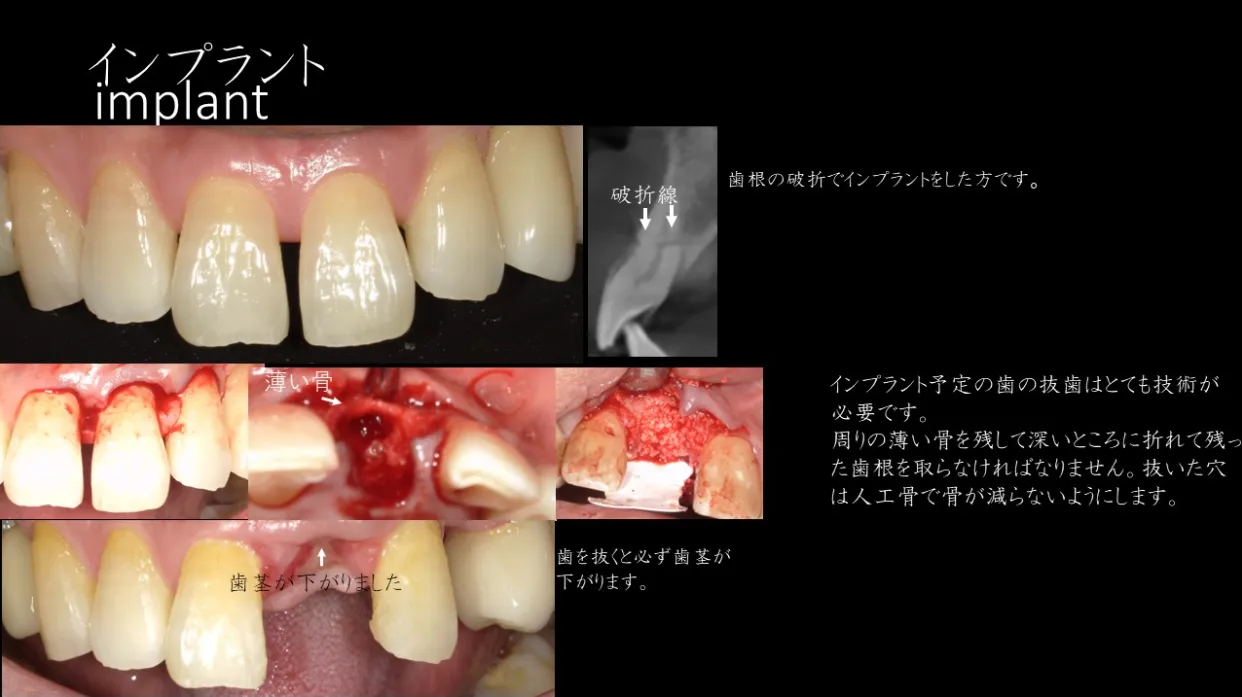
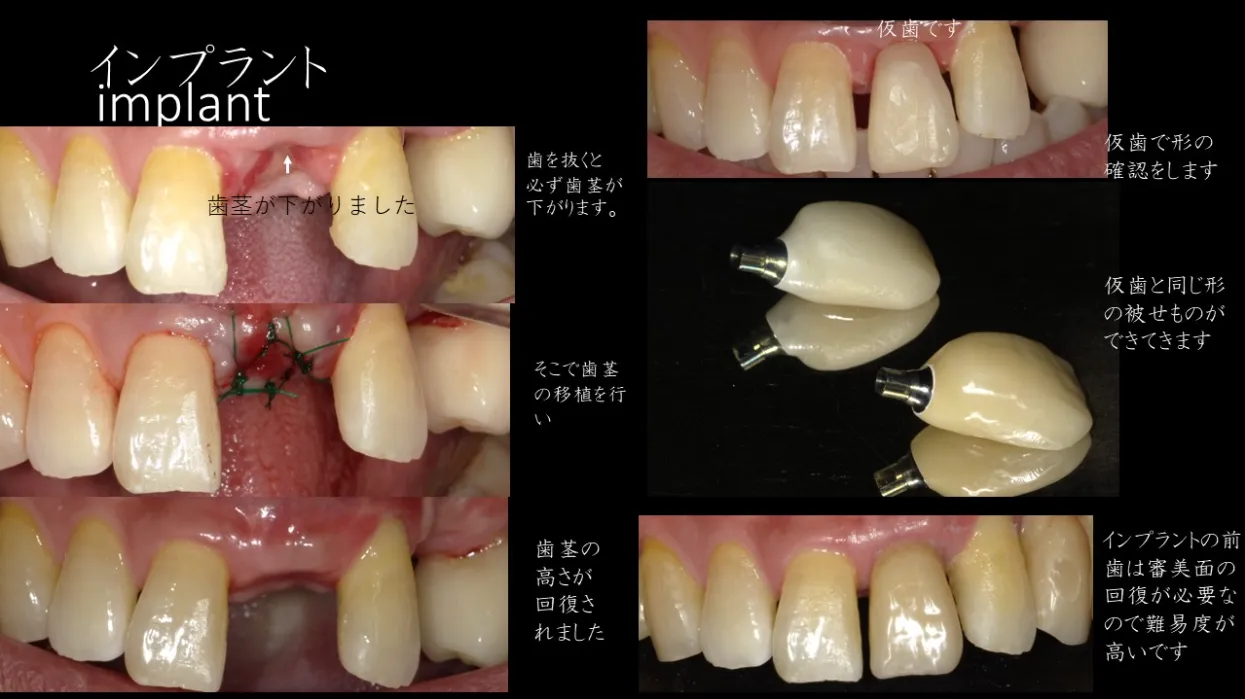
Appearance risks (especially for front teeth)
This refers to the risk that, after the gums recede, the titanium part can show through with a dark tint, or the crown can end up looking unnaturally long.
Cause ① Brushing too hard, or insufficient thickness of the bone or gum tissue itself
Countermeasure ① by our clinic
We will guide you on brushing with the correct amount of pressure, and if the bone or gum tissue around a front tooth is diagnosed as too thin, we will also carry out a procedure to build up the bone or gum volume artificially (grafting), working to help you maintain a beautiful smile over the long term.
Other health-related precautions
○Patients who are pregnant, may be pregnant, or are breastfeeding should postpone treatment, out of consideration for the strain it can place on the body.
○Because implant treatment involves surgery, it can sometimes be difficult to proceed as-is for patients with systemic conditions such as diabetes, heart disease such as high blood pressure, or osteoporosis. Patients taking anticoagulant (blood-thinning) medication must also be sure to let us know beforehand.
○If the mouth is in an unhygienic state due to severe periodontal disease or similar, we may start with periodontal treatment first, to lower the risk of bacterial infection.
○For a few days after surgery, you may experience swelling, pain, or internal bleeding (bruising), but this will gradually subside with medication — please feel free to talk to us anytime if you’re concerned.
○Patients with any of the following conditions should, wherever possible, discuss it with the treating dentist at the first visit.
・Heart or blood vessel disease (high blood pressure, myocardial infarction, etc.)
・Respiratory disease (asthma, etc.)
・Liver, kidney, or gastrointestinal disease
・Diabetes, osteoporosis, or thyroid disease
・Metal allergy or drug allergy
・Any condition currently being treated, or treated in the past, and any related medication (especially osteoporosis medication)
Aftercare to make your treatment last longer
The secret to using your implant for a lifetime lies entirely in “aftercare” after treatment. Beyond brushing every day, it is also very important to use interdental brushes and floss so that no debris is left around the implant.
歯科ハミール in Handa recommends a check-up every 3 months. We will thoroughly clean the debris you can’t remove yourself using dedicated instruments, and carefully check whether your bite has become unbalanced with a professional eye.
In addition, the conditions for post-treatment support and maintenance vary depending on the treatment provided, the materials used, and whether regular check-ups are kept up, among other factors. Let’s confirm the applicable conditions and scope beforehand, and work together to keep your implant in good shape for the long term.
Is it really safe? Implant survival rates and track record
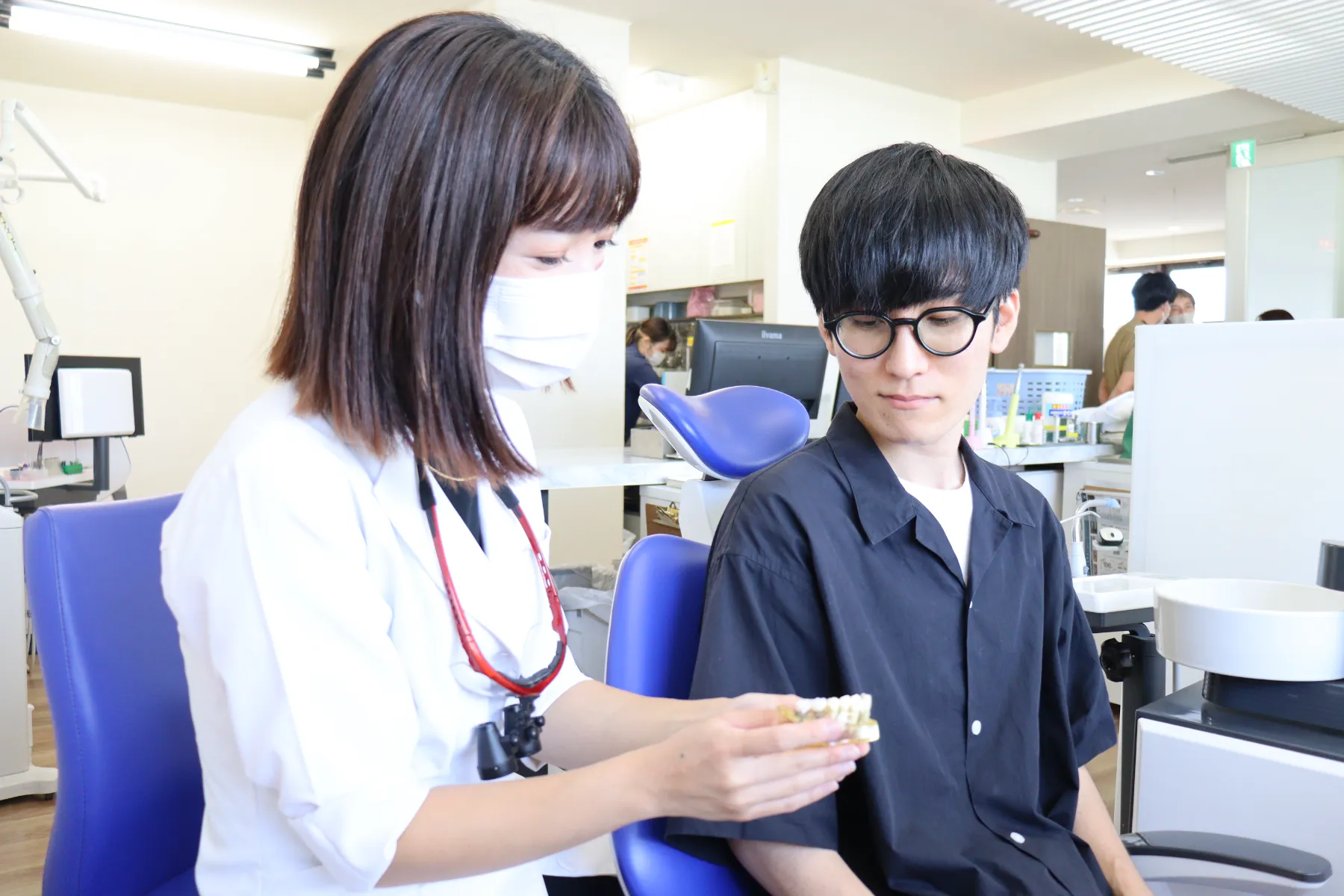
We often hear things like “I’m scared of the surgery” or “I’ve heard about cases of trouble, and it worries me.” However, most problems arise from insufficient examination beforehand or inadequate maintenance after treatment.
As long as surgery is carried out in a good environment and you come in regularly for care afterward, the 10 to 15-year survival rate for implants is considered to be a relatively high 90–95%.
Our clinic maintains thorough CT equipment and hygiene management, and completes over 100 implant treatments a year. Backed by more than 30 years of clinical experience, we draw up safe treatment plans — so please come talk to us first, worries and all.
FAQ about dental implants
Q1. What exactly is a dental implant?
It is a treatment in which a small titanium screw (an artificial tooth root) is placed into the jawbone where a tooth is missing, and a false tooth is then attached on top, so you can bite down just like with a real tooth.
Q2. What are the advantages of implants compared with a bridge or dentures?
The biggest appeal is that, without grinding down your remaining healthy teeth or placing a load on them through clasps, you can regain a firm bite just like your own teeth, using only the missing spot.
Q3. Does it hurt during surgery?
We use plenty of local anesthesia during surgery, so you will almost never feel pain. Once the anesthetic wears off afterward, you may have some swelling or pain for about 2–3 days, but this can be eased with pain medication.
Q4. How long does the surgery take?
Please expect placing a single implant to take around 60 minutes. If bone grafting or a similar procedure is carried out at the same time, it may take a bit longer.
Q5. Once it’s placed, will it last a lifetime?
Generally speaking, it is said to be usable comfortably for 10 to 15 years or more, but if you neglect brushing or skip regular check-ups, it could come loose after just a few years. On the other hand, with proper care, it can last 20 or even 30 years, becoming a tooth that stays with you for life.
Q6. Can smokers still get treatment?
It’s not that treatment is impossible, but smoking significantly hinders integration with the bone and greatly raises the risk of treatment failure. For this reason, we ask you to quit smoking for at least a week before and after surgery.
Q7. I was turned down at another clinic because my bone was “too thin”…
Our clinic can handle advanced techniques such as “bone augmentation surgery (GBR, an internal sinus lift, and so on)” to artificially increase bone volume. Even if you were turned down elsewhere, there’s a good chance treatment is still possible for you — please don’t give up, and come talk to us first.
Q8. Is it a problem if I have a metal allergy?
The “titanium” used in implants is a metal also used in fields such as artificial joints, and it is extremely unlikely to trigger an allergic reaction. That said, if you have a severe titanium allergy, extra care is needed, so please talk to us beforehand.
Q9. Can I get treatment if I have a chronic condition?
If you have a chronic condition such as diabetes or high blood pressure, whether treatment is possible depends on your medication and how well your levels are controlled. We will stay in contact with your physician and assess together whether treatment can proceed safely, so please let us know about your condition at your consultation.
Q10. Does the cost of treatment qualify for the medical expense deduction?
Yes, the cost of implant treatment qualifies for the medical expense deduction. Filing an income tax return will refund part of the tax you’ve already paid. Please keep your receipts safe.
歯科ハミール in Handa’s
implant treatment case studies
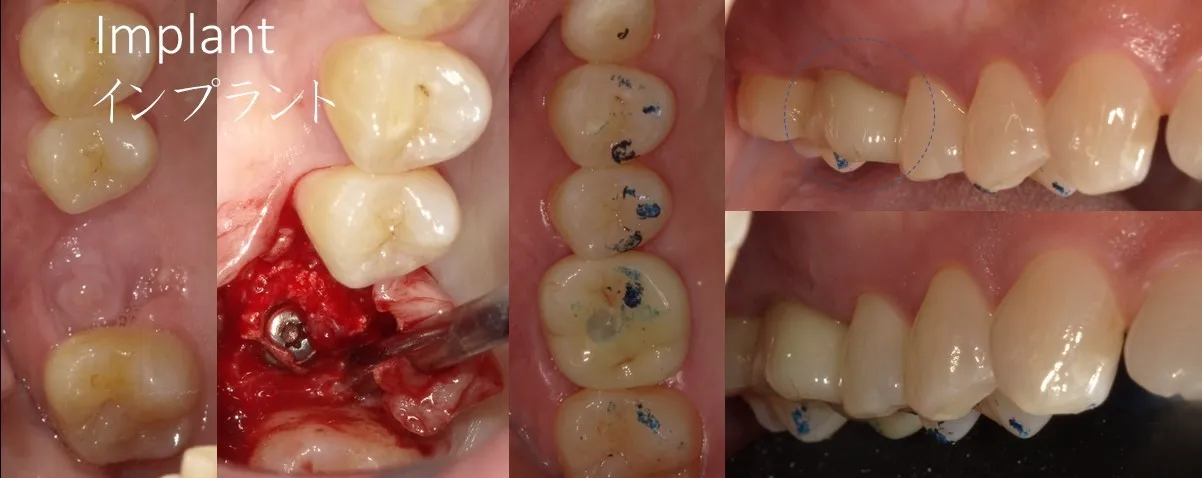
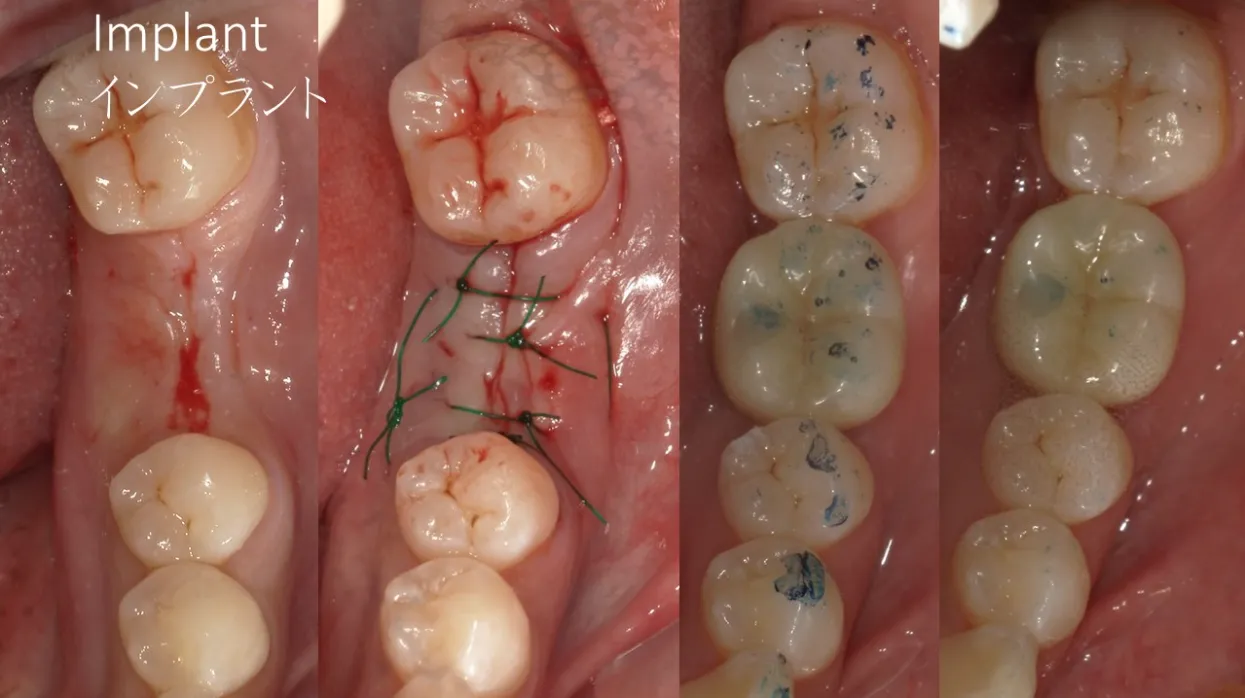
Case 1: Molar implant
This is the case of a patient whose own tooth had fractured, requiring extraction. Wanting to “bite down firmly on hard foods like before,” the patient chose implant treatment for the second-to-last position on the lower right. The examination showed insufficient bone volume in the jaw, so a procedure to artificially add bone (bone grafting) was carried out at the same time, and treatment was completed safely after building a solid foundation.
Booking & Inquiries